
DOCTORAL CONSORTIUM
TICEC 2026 - Doctoral Consortium
The Steering Committee of the 14th edition of TICEC, Ecuador’s flagship conference in Information and Communication Technologies (ICT), invites PhD candidates to participate in the Doctoral Consortium (DC), a space designed to provide specialized feedback and foster interaction with experienced researchers. This event is aimed at PhD candidates at different stages of their research who seek constructive guidance on their thesis projects.
Objectives
The TICEC 2026 Doctoral Consortium aims to:
- Provide a forum for PhD candidates to present their ongoing research and receive feedback from experts and other participants.
- Foster interaction and networking between PhD candidates and established researchers in the ICT field.
- Help PhD candidates improve the quality and direction of their research through constructive suggestions.
- Create an academic and professional support environment that enables PhD candidates to strengthen their research projects.
Topics
The TICEC 2026 Doctoral Consortium covers various ICT research areas, including but not limited to:
- AI, Data Science, and High-Performance Computing for Key Sectors
- Digital Health, Bioengineering, and Clinical Interoperability
- Integrated Sustainability: Climate, Water, Risk, and Smart Energy
- Production and Territory 4.0: Agrotech, Materials, and Advanced Manufacturing
- Digital Society: Government, Education, Identity, and Trust
Benefits
- Receive detailed feedback from ICT experts.
- Exchange ideas with other PhD candidates and expand your academic and professional network.
- Gain recognition for your research and contribute to advancing knowledge in ICT.
- Participate in specialized sessions that will help improve doctoral research.
- Have the opportunity to publish your research in a high-impact indexed series.
Important dates
Call for papers opens
March 15, 2026
Paper submission deadline
June 28, 2026 (23:59, UTC -5)
Author notification
July 15, 2026
Revised version submission
August 1, 2026 (23:59, UTC -5)
Final author notification
August 15, 2026
Author registration deadline
September 16, 2026
Publication
Accepted papers in the Doctoral Consortium will be included in the TICEC 2026 proceedings, published in the prestigious Springer Communications in Computer and Information Science (CCIS) series, indexed in:
- DBLP
- Google Scholar
- EI-Compendex
- Mathematical Reviews
- SCImago
- Scopus and more…
Read all the instructions below carefully before uploading your paper!
Submission and review process
Each submitted paper will undergo a rigorous double-blind peer-review process, in which its originality, research depth, accuracy, relevance to the conference topics, and clarity will be assessed.
Make sure you fully understand the submission guidelines by carefully reading the call for papers before submitting your work.
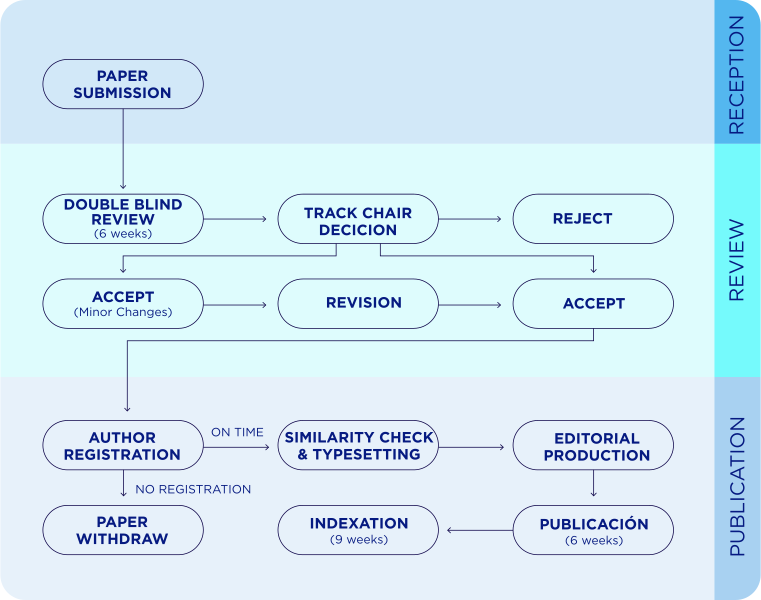
Prepare your paper
Submission guidelines
Required format: Only submissions in PDF format are accepted.
Anonymity for review: Do not include author names, universities, countries, or any identifying information in the document. These details must be provided exclusively through EasyChair, in accordance with the double-blind review process.
Language: Papers must be written in English; this includes tables and figures. Papers that do not meet these requirements will be immediately rejected (desk rejection).
Length: Only FULL PAPERS with a length of 12 to 15 pages are accepted. Papers that do not meet these requirements will be immediately rejected (desk rejection).
No edits after submission: No modifications are allowed once papers are submitted for review, including authors or references.
Author limit: A conference paper, due to its length and venue, should not exceed 6 authors. If there are more than 6 authors, consider developing the work into a journal article.
Originality and relevance: Content must be original and aligned with one or more conference topics. A plagiarism analysis will be performed prior to sending the paper to review.
Self-citation: Papers in which more than 20% of the references cite authors of the paper under review will be automatically rejected (desk rejection).
Accuracy in details: Verify the accuracy of citations, diagrams, maps, and tables before submitting your work.
Placement of figures and tables: Insert figures and tables in the appropriate place within the text, ensuring they are clear and high resolution.
Use of generative artificial intelligence: All papers must include an AI usage statement and specify how it was used, acknowledging that the authors are responsible for the content generated for the paper.
Template compliance: Papers must strictly follow the template provided in the templates section. Papers that do not follow the LaTeX template will be immediately rejected (desk rejection).
Acceptance criteria
Each paper will be evaluated by at least three regular members of the Program Committee or two senior members of the Steering Committee. Evaluation criteria include:
Originality: The paper must present new ideas, projects, or problems, offer new perspectives on existing research, introduce new lines of research, or propose innovative approaches to existing information.
Engagement: The paper presentation should be engaging for the audience and have strong potential to capture the interest of conference attendees, responding to the community’s needs.
Significance: It must address key topics that contribute to improving the effectiveness and/or sustainability of open education, ensuring the content is easy to disseminate and understand.
Quality: Claims must be supported by appropriate data, references to relevant literature, and an honest presentation of the study limitations.
Clarity: Objectives and expected results must be defined in a clear and understandable manner.
Relevance: The work must directly address one or more of the conference topics.
Transparency: Any paper that presents a new tool, a framework, or research data must include the respective repositories for transparency verification (GitHub, Zenodo, etc.).
Contribution: Short papers and position papers are not accepted.
Template
Download the author guidelines (English only)
Download the LaTeX template
Academic ethics policies
Plagiarism check: All contributions submitted to TICEC 2026 will undergo a plagiarism review, including self-plagiarism. Papers containing plagiarism will be automatically rejected (desk rejection).
Authorship: Once a paper is accepted, no authors may be added beyond those listed in the EasyChair submission form when uploading the paper for its first review. Failure to comply implies rejection, even if the paper was previously accepted.
Revisions: Accepted papers must be revised according to reviewers’ comments and recommendations. It will be verified that the papers implement reviewers’ feedback.
Registration policy: Each registration allows only one author to attend and present the paper in person. Additional authors may register at the attendee price. Please review the registration page.
Publication rule: Only one paper may be presented and published per registration.
Cancellation policy: No cancellations or refunds are allowed once registration has been completed.
Transfer policy: Registrations are strictly non-transferable.
Presentation requirement: Publication of a paper is conditional upon its presentation at the conference.
Non-compliance with academic ethics policies, in addition to rejecting the paper, will be reported to the authors’ affiliated institutions.
Awards
At TICEC 2026, attendees and participants will witness the presentation of two prestigious awards, recognizing:
Best Paper Award: Granted to the most outstanding paper in its session.
Best Presentation Award: Granted to the best presenter of the day.