
CALL FOR DEMOs
TICEC 2026 - Call for DEMOs
The TICEC 2026 Demonstrations Track aims to showcase the latest advances in Information and Communication Technologies (ICT) through compelling, hands-on demonstrations that bridge the gap between research and practice. This track serves as a highly interactive venue where researchers and practitioners can present their tools, prototypes, or technological solutions and engage in direct dialogue with conference attendees.
Submission Scope
Tool-based demonstrations should describe novel aspects of either early-stage prototypes or mature technologies, including innovative features of established tools. All submissions must clearly communicate:
- Envisioned Users: Who is the target audience for this technology?
- ICT Challenge Addressed: What specific problem within our conference tracks (e.g., AI, Smart Cities, Digital Health) does this tool solve?
- Methodology/Workflow: What is the required user journey or technical workflow?
- Validation: Results of validation studies (for mature tools) or the design of planned studies (for early prototypes).
Integrated Contributions
Highlighting scientific contributions through concrete artifacts is a critical supplement to traditional TICEC research papers. A demonstration provides the opportunity to communicate how a scientific approach has been implemented or how a specific hypothesis has been assessed—including details such as data models, API access, and implementation challenges.
Note for Research Track Authors: Authors of regular research papers (Scientific and Technical Track) are strongly encouraged to submit an accompanying demonstration paper. In these cases, the tool paper must provide additional, distinct information regarding implementation and usage that was not covered in the original research paper.
Evaluation Criteria
Each submission will be reviewed by at least three members of the TICEC Demonstrations Program Committee. Submissions will be evaluated based on:
- Relevance: Alignment with the TICEC 2026 audience and thematic tracks.
- Technical Soundness: The robustness and validity of the technological approach.
- Novelty: The originality of the underlying ideas, concepts, or applications.
- Presentation Quality: The clarity and impact of the associated video demonstration.
- Utility: Potential applications and practical usefulness of the tool in real-world scenarios.
- Context: Proper consideration of relevant literature and existing solutions.
Important dates
Call for DEMOs opens
March 01, 2026
DEMOs paper submission deadline
June 28, 2026 (23:59, UTC -5)
Author notification
August 9, 2026
Final version submission
August 16, 2026 (23:59, UTC -5)
Author registration deadline
September 16, 2026
Publication
The proceedings of TICEC 2025 will be published in the prestigious Springer Communications in Computer and Information Science (CCIS) series. This ensures that the high-quality research presented at our conference is widely accessible and recognized within the academic community.
The CCIS series is indexed in several leading databases, including:
- DBLP
- Google Scholar
- EI-Compendex
- Mathematical Reviews
- SCImago
- SCOPUS
Read all the instructions below carefully before uploading your paper!
Submission and review process
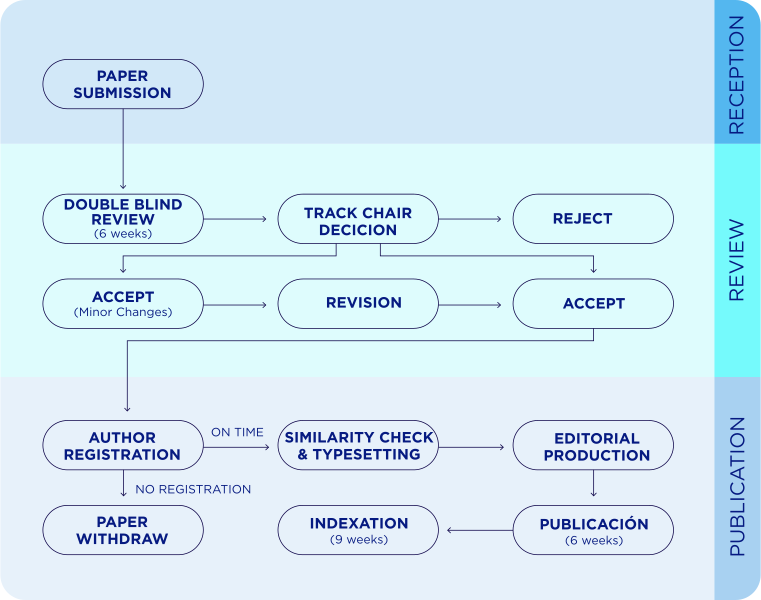
Each submitted paper will undergo a rigorous double-blind peer-review process, in which its originality, methodological rigor, technical accuracy, relevance to the conference topics, and clarity of presentation will be assessed.
** Before submitting your work, read the call for papers carefully and make sure you understand and comply with the submission guidelines.
Prepare your paper
Submission guidelines
- File format: Only submissions in PDF format will be accepted.
- Anonymity (double-blind review): The document MUST NOT include author names, affiliations, acknowledgments, or any other information that could identify them. This information will be recorded exclusively on the EasyChair platform.
- Language: The entire paper, including tables, figures, and captions, must be written in English. Papers that do not meet this requirement will be immediately rejected (desk rejection).
- Length: Only WiP papers (short papers) with a length of 8-10 pages, as per the official template, will be considered. Papers outside this range will be rejected without review (desk rejection).
- Template: Strict use of the official LaTeX template available in the templates section is mandatory. Papers that do not use it will be immediately rejected.
- Originality and thematic alignment: Content must be original and aligned with at least one of the conference themes. All submissions will undergo a plagiarism analysis before peer review.
- Self-citation: Papers in which more than 20% of the references correspond to authors of the same paper will be automatically rejected (desk rejection).
- Co-author limit: The maximum number of authors per paper is 6. For works with more contributors, consider developing them into journal articles.
- No changes after submission: No changes to the manuscript will be allowed after submission, including authorship or references.
- Accuracy and quality of graphical elements: Verify the accuracy of citations, diagrams, maps, and tables. All figures and tables must be inserted in the appropriate place in the text, with print quality and high resolution.
- Use of generative artificial intelligence: All papers must include an AI usage statement detailing its purpose and scope within the work. Authors assume full responsibility for all content in the paper.
Acceptance criteria
Each paper will be evaluated by at least three regular members of the Program Committee or two senior members of the Steering Committee. Evaluation criteria include:
- Originality: The work must present novel ideas, methods, findings, or perspectives in the ICT field.
- Relevance and thematic alignment: Content must directly address one or more of the themes established by the congress and demonstrate its importance to the area.
- Value for the audience: The paper presentation should be engaging for the audience, ensuring the technical content is easy to disseminate and understand. It must have strong potential to capture the interest of conference attendees and respond to the community’s needs.
- Rigor and quality: Claims and conclusions must be supported by data, appropriate analysis, and references to specialized literature. A clear discussion of study limitations must be included.
- Clarity: Objectives, methodology, results, and conclusions must be presented in a logical, precise, and understandable manner.
- Transparency: Any paper that presents a new tool, a framework, or research data must provide links to the respective public repositories for transparency verification (GitHub, Zenodo, etc.).
Note: Only full papers that meet all formal and length requirements (12-15 pages) will be considered for review.
Template
Download the author guidelines (English only)
Download the LaTeX template
Academic ethics policies
- Plagiarism check: All contributions submitted to TICEC 2026 will undergo a plagiarism review, including self-plagiarism. Papers containing plagiarism will be automatically rejected (desk rejection).
- Authorship: Once a paper is accepted, no authors may be added beyond those listed in the EasyChair submission form when uploading the paper for its first review. Failure to comply implies rejection, even if the paper was previously accepted.
- Revisions: Accepted papers must be revised according to reviewers’ comments and recommendations. It will be verified that the papers implement the feedback provided by the reviewers.
- Registration policy: Each registration allows only one author to attend and present the paper in person. Additional authors may register at the attendee price. Please review the registration page.
- Publication rule: Only one paper may be presented and published per registration.
- Cancellation policy: No cancellations or refunds are allowed once registration has been completed.
- Transfer policy: Registrations are strictly non-transferable.
- Mandatory presentation: Publication of a paper is conditional upon its presentation at the conference.
For non-compliance with academic ethics policies, in addition to rejecting the paper, the authors’ affiliated institutions will be notified.
Awards
At TICEC 2026, attendees and participants will witness the presentation of four prestigious awards, recognizing outstanding contributions in different categories:
- Best Paper Award: Granted to the most outstanding paper in its session.
- Best Presentation Awards: Recognized in two categories:
- Female presenter
- Male presenter
- Contributor of the Year Award: Granted to the institution with the highest number of accepted papers at the conference, in recognition of its important contribution to the field.